With consumer behaviors constantly evolving, how can your brand portfolio strategy remain focused, customer-centric, and relevant to enable your parent company to be valued as more than a ‘holdco’? In this paper, we will unpack how you can structure your portfolio to optimize its value. We’ll also share our proprietary ‘5 Ms’ approach to help you unlock maximum value while improving the real and perceived value of your parent company.
Many of the companies we work with have a portfolio of brands (or ‘banners’, in the case of retailers). Often the portfolio grew through acquisition, sometimes in the service of a clear long-term vision and strategy and sometimes opportunistically — the acquisitions just made sense at the time. Over time, however, these portfolios tend to become more a collection of parts than a cohesive whole. Value creation ends up relying entirely on the performance of each brand within a portfolio rather than on the strategic and more lucrative play of a carefully orchestrated set of pieces working in harmony to great benefit. Benefits of the latter approach are many: maximizing strategic advantage; delivering the greatest amount of market share; optimizing performance; minimizing costs through shared and foundational synergies; extracting value across customer life stages; and, having the parent company seen as more than a ‘holdco’, clearly adding value and the secret sauce of success. The discipline of ensuring the pieces come together into a more powerful and valuable whole is an often overlooked aspect of financial stewardship. Building and regularly updating an integrated portfolio strategy is not simply a worthwhile exercise, it is essential hygiene for maximizing enterprise value and amplifying strategic differentiation.
For example, consider one of the top parent companies in the world: Unilever. Quite obviously, the total value of their portfolio is greater than the sum of the individual brands and companies from which it is made. They have an overarching strategy that can easily be articulated; each piece of the portfolio is there to serve it, and it does so by playing a precise and complementary role. A key driver behind Unilever’s success is that they have maintained a laser focus on serving the ever-changing customer, and this customer focus is the bedrock for how they evolve and optimize their portfolio through the creation, acquisition, evolution and even shedding of brands. In these regards as in other instances of sound strategy development, it pays to start with the customer. Particularly today, when the pace of change in customer attitudes is at an all-time high.
The Value of an Integrated, Customer-Centric Portfolio Strategy.
There has been no greater force for change with customers in recent years than the COVID-19 pandemic, which radically disrupted customer values, preferences, and shopping behaviors. In almost two decades of assisting leaders to refresh and transform their businesses, we at Jackman have yet to witness as dramatic a shift in what customers want as in the last 18 months. The implications for consumer brand businesses have been profound. Beyond seeking ways to adapt to the disruption, many parent companies found their legacy brands lagging an evolving set of consumer expectations and quickly scrambled to pivot these brands while casting a wider net through M&A or by quickly launching new brands. These actions may have yielded the short-term financial fix required, yet in many cases the aftermath of the pandemic are portfolios with less than sharply positioned and often overlapping brands. In the case of those with legacy brands, many of which have fallen offside of today’s consumer expectations, the return to relevance and growth will require more than a quick fix and instead a holistic reset of portfolio strategy.
Whichever specifics of the above scenario are closest to your situation, an integrated, customer-centric portfolio strategy will resolve both old and new challenges exacerbated by the pandemic and pave the way for incremental growth. Without this kind of regular review, a portfolio left to organically evolve over time is at risk of becoming stagnant, undervalued, and worse, irrelevant.
Before we dive into the ‘how’ of developing an integrated, customer-centric portfolio strategy, here are three major benefits of having one:
- Strategic clarity ensures the highest possible relevance with customers.
- It defines sharp and distinct positions for each portfolio brand by tying them to specific customer segments and what they care about most deeply.
- It establishes opportunities for growth and guardrails for maximizing portfolio-level share.
- Focused internal efforts reduce redundancy and cannibalization and drives organizational alignment.
- It aligns core elements within the organization to sharpen the go-to-market strategy and day-to-day operations individually and across the portfolio.
- It ignites cultural change and rallies internal stakeholders behind a focused strategy.
- Tight link between the strategic narrative and current/future portfolio unlocks a higher multiple.
- It defines the role of each entity in the portfolio and draws a straight line from that to a crisp and overarching strategy.
- It creates a clearer and more compelling narrative.
- It unlocks back-end operational efficiencies and organizational leverage, the ‘whole’ enabling and turbo-charging the ‘parts’.
As we slowly emerge from the pandemic, with so much having changed, now is the time to look again at your portfolio strategy.
The Keys to Optimizing Your Portfolio.
There is not a one-size-fits-all strategy to bolster the value of your portfolio and maximize market share growth potential. There are, however, two key conditions; your portfolio must be:
- Built for Customers – Each brand within your portfolio is precisely situated to attract and win with distinct customer segments; and
- Powered by the Parent – The parent company is adding meaningful value and purpose to each portfolio brand.
There are multiple ways to fulfill these two conditions and thus maximize enterprise value. Let’s first review how these two conditions can be met and brought to life.
1. Built for Customers
The power of multiple brands in a portfolio is that they offer an enterprise the flexibility to show up in different ways to different customer segments, thereby enabling a larger share of the market overall. Brand portfolios work best when they are structured around various organizing principles, such as geography, sub-category or format, price/value, occasion or service expectations. Parent companies typically use at least two to create a matrix for positioning brands to maximize share. In the case of Marriott International, who believes that providing a wider range of hotel offerings increases the odds that customers will choose one of theirs, has organized their portfolio around value and service expectations. In this case, their Ritz-Carlton and St. Regis brands are focused on providing luxurious service at a higher price point, while their endorsed brands such as Courtyard and Fairfield Inn are focused on value, operating at mid and lower-tier price points.
In our experience the most successful portfolios are rooted in a deep understanding of customers; it is customer need states that inform the basis for the framework, therefore the first organizing principle is “Which customer segments can, and will we focus on?”. This will naturally inform second order decisions such as positioning on value, service/experience expectations, occasion, etc. As a simple illustration, think of Dove and Axe, two important and familiar brands within the Unilever portfolio. Although these two brands are focused on serving commodity products, they clearly play different roles and serve different needs for distinct customer segments, and that is the foundation of their place within the Unilever portfolio. Consideration of where to play and how to win within the fiercely competitive personal care landscape is rooted in customer focus and insight: which customer is the brand for, and what do these customers care most deeply about? Price/quality level, occasion, and other positioning considerations would naturally be follow-on choices, and these would also be rooted in customer focus and insight alongside competitive positioning considerations.
This first leg of laying the foundation for the most effective portfolio is straightforward, in that it involves defining the distinct and addressable customer segments across any given category — those that could be targeted — and then pinpointing which brand will be distinctly positioned to which segment, and how that will unlock growth. At this stage it is wise to avoid overlapping positions from the perspective of customers, as the less overlap the more distinct and powerful each of the brands can become. Once done, completing this first phase of portfolio strategy optimization requires stepping back from the individual customer segments, now matched to existing brands, and looking at how the portfolio overall delivers against total addressable opportunity. Do the brands you deploy address the entire opportunity? Are there gaps and are they worth filling? It’s a fascinating and data-underpinned process that can point the way to substantial opportunity for incremental growth for both current and future brands.
Beyond this ‘ground up’, Built for Customers approach, there is a second layer to unlocking value; specifically, the Powered by the Parent approach aimed at delivering the full power of the portfolio as a whole.
2. Powered by the Parent
With the portfolio now sharpened from a ‘which brands are positioned for which customers’ perspective, the second key to optimization is clarifying the value brought to each brand proposition by the parent company and understanding how it enables success at the brand level while creating incremental value at the portfolio or enterprise level (in other words, how the whole becomes much more valuable than the sum of the parts).
Again, in the case of Unilever, Dove, Axe, and the rest of the 400+ portfolio brands, all are united by the parent company’s commitment to caring for people and the planet. This clarity, in both intentions and actions, not only bolsters the competitive position of all the brands within the portfolio, but it gives the parent company its own clear position, narrative, and path to value creation. Is Unilever valued solely on the financial performance roll up of its brands, or is its current valuation in part attributable to the power of its position, purpose, and portfolio of leading and enabled brands? According to the company, “We’re driven by one simple purpose: to make sustainable living commonplace” After refining this strategic intention in 2012, the global value of the company began to improve substantially. Unilever’s stock price broke through a multi-year plateau and rose steadily over the next decade. This clear strategy continues to shape the overall portfolio. When CEO Alan Jope was brought on in 2019, he reinforced this vision by stating Unilever would discontinue brands that failed to articulate a clear social or environmental purpose (despite being profitable).
To achieve a similar state as Unilever in which the whole is greater than the parts, parent companies must look inward to determine who they are and what they stand for. Specifically, parent companies need to identify the key emotional and functional customer benefits they provide and the value they can authentically deliver. By unlocking these strengths, parent companies can strategically reinforce and communicate the specific benefits that best align to their customer’s needs. Most importantly, any decisions made at the parent company level must also consider the role that each brand in the portfolio can (or is intended to) play.
An understanding of the parent brand’s relationship with existing (or prospective) portfolio brands will ultimately inform the ideal brand portfolio architecture. A well-structured brand architecture demonstrates how the sub-brands of a larger whole are organized, acting as a framework for customers to navigate and conceptualize the offerings. Internally, it provides guidelines to prioritize strategic growth and helps to simplify the integration of new brands into the portfolio.
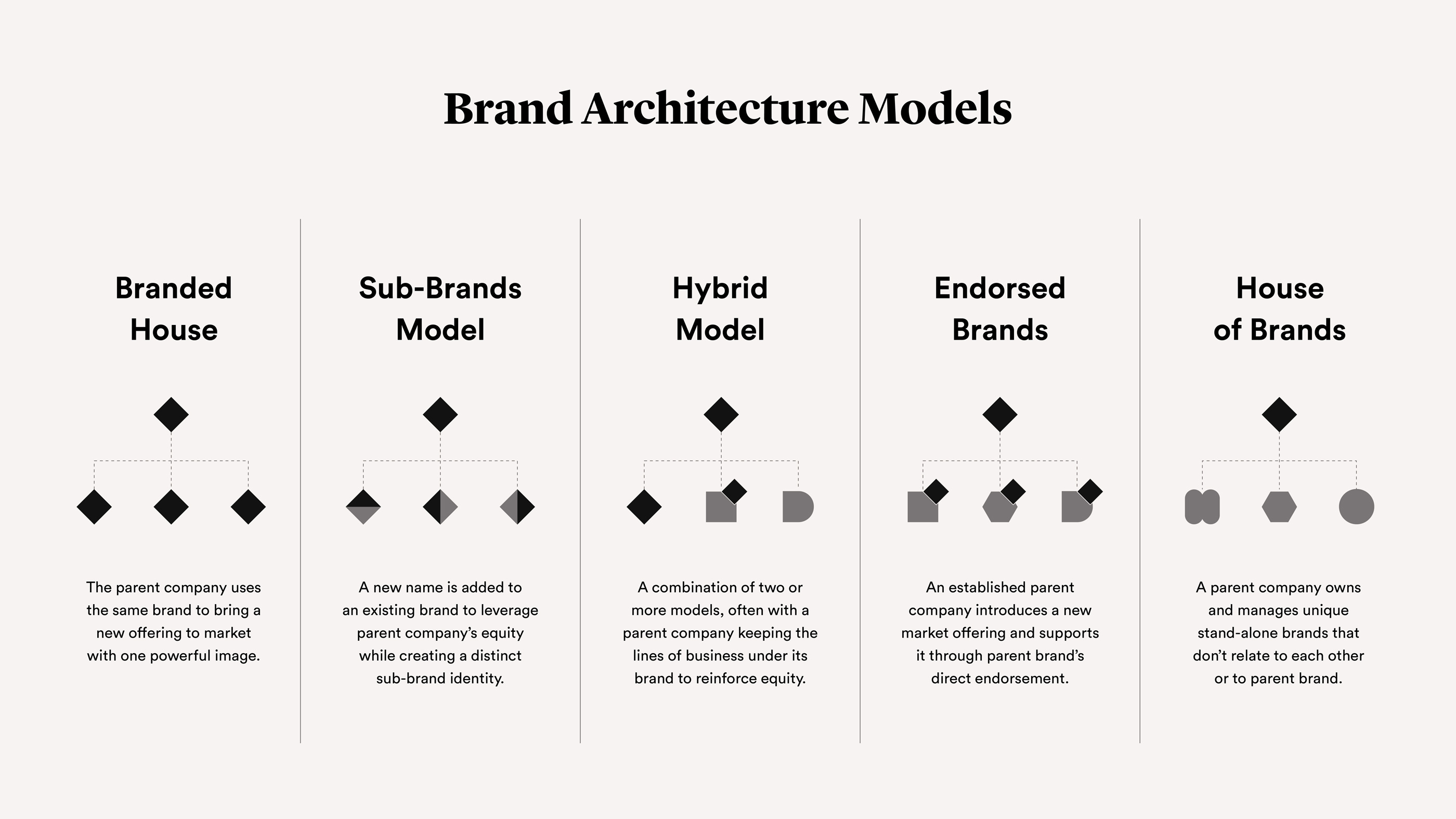
When formalizing a brand architecture, parent companies are inherently deciding the primary role they will assume. As illustrated above, a parent company is generally more visible in a Branded House than a House of Brands model. However, this does not necessarily mean that the parent company in a House of Brands is never customer-facing. If we follow the case of Unilever, most of their marketing efforts are focused on the portfolio brands, but the parent company does also run global marketing campaigns to support their vision of making sustainable living commonplace.
Your brand architecture will also outline additional ways for the parent company to add value beyond a unified purpose. In a Branded House, for instance, the parent company disseminates value throughout the portfolio in the form of brand equity. On the other hand, a parent company in a House of Brands model often serves to enable functional value through shared back-end services, infrastructure, and/or other resources.
This raises another important consideration when choosing a brand architecture — how much do you intend to leverage the equity of your parent company to strengthen the connection of the portfolio? Business leaders need to understand what underlying thread ties all brands in the portfolio together (or ties each to the parent company), and what existing equity the parent brand has with customers. For example, we helped Caesars Entertainment unify its assets and organize its portfolio by identifying a clear role for the parent company and a tight connection to all banners. The existing level of recognition and equity with the ‘Caesars’ name empowered the parent company to adopt a customer-facing architecture. In this model, all banners are endorsed by Caesars Entertainment and connected by the Caesars Rewards loyalty program, both of which drive equity back to the parent company.
Regardless of the brand architecture model you choose, your decision regarding the parent company’s role will provide a clear path for the business and ultimately satisfy the second key condition required to amplify your portfolio’s value.
Bringing it Together: Signet Jewelers Case Study
By now it’s clear that the power to realizing the full potential value of your portfolio is only unlocked when both strategic conditions are met — it is Built for Customers and Powered by the Parent. At Jackman, we worked closely with Signet Jewelers to help them fulfill these two key conditions and amplify their growth potential, which we’ll briefly unpack below.
The process began by ensuring Signet’s portfolio strategy was structured around distinct customer needs, specifically within the areas of ‘self-expression’ and ‘expression of love’. After conducting thorough consumer mindset segmentation and mapping the total potential customer landscape, we uncovered opportunities for Signet to sharpen the focus and positioning of existing brands within their portfolio as well as identify whitespace for future brand development. The resulting clarity at the brand level — where to play and how to win with whom — served to optimize performance of each while at the same time laying out the path to optimizing portfolio performance in aggregate. We then worked with Signet’s leadership team to re-imagine the value proposition and customer experience of each newly and distinctly positioned brand to amplify what will make it different and deeply resonant with targeted segments. With each brand and its benefits crisply articulated, and overlap in the eyes of customers minimized, market share and performance potential could be maximized.
In parallel with the above, we supported Signet on their journey to clarify the role of the parent company, so that it would add further value to each banner, while creating an even more compelling position and narrative for itself. With direction, Signet’s leadership team aligned on a higher purpose for the parent company, which is to celebrate life and express love. This refined mission is emanated across the organization via the CEO and has positioned Signet to disseminate value across the portfolio through benefits of scale. These benefits include consumer-inspired insights, instilling a culture of innovation and agility, and winning with consumers wherever, whenever, and however they want to engage. Although Signet’s mission is not customer-facing, the aforementioned benefits come to life in distinct ways through each banner as they are ultimately powered by the parent company.
With the two critical conditions in place, Signet Jewelers is well-poised for future growth and is already starting to realize the value of this essential brand portfolio strategy work.
The 5Ms: Jackman’s Process for Strengthening Portfolios
At Jackman, we evaluate and optimize portfolios utilizing a “5M” lens: Mindset, Market, Meaning, Mapping, and Momentum. This process ensures thorough strategic planning at any stage of portfolio development — from new acquisitions to iterative portfolio reviews. More importantly, this proprietary approach enables our engagement partners to take the critical steps required to ensure their portfolio is Built for Customers and Powered by the Parent.
MINDSET: Begin with Understanding Your Customers
To determine the structure that works best for you, begin by truly understanding your customer, beyond their demographics. This requires comprehensive market research and insight into several key questions: What do customers really want? What do they value? Which characteristics set them apart? The ideal market research plan will:
- Explore attitudes to tap into who people are and what they truly seek, identifying ways to engage with them on an emotional level.
- Uncover underlying purchase motivators and unmet needs.
- Create meaningfully distinct customer segments.
- Understand which segments you can — and should — prioritize to home in on unique opportunity areas for future brand development.
- Measure existing brand equity or affinity for your brands and brands within the competitive set, revealing any whitespace and overlap in the market.
MARKET: Competitive Landscape Considerations
Evaluate the competitive landscape to gain a holistic view of all the players in the market. How does it overlay with your growth strategy to determine whether your current offerings play unique roles versus other brands? This will require:
- Keeping tabs on trends and market shifts both inside and outside your industry. Doing so will help you understand the disruptors you need to be mindful of, where new opportunities are emerging, and where you have ambition to cover in the future.
- Uncover whitespace. At the intersection of mindsets and competitive landscape is an opportunity to identify whitespace. There may be a customer need that is not being met (or sufficiently met) by the existing brands in the market, and that one (or more) of your brands is well-positioned to fill.
MEANING: Create Clear Propositions and Offerings
Align your portfolio brand value propositions to customer mindsets. This opens the door to new opportunities, drives growth, and builds long-term brand advocacy. This requires you to determine which key benefits are best provided and communicated by the parent company versus the portfolio brands:
- Identify your strengths as a parent company and determine how they directly align to the key benefits customers seek.
- Clarify these strengths to also offer an area in which the culture can reinforce and rally behind.
- Ensure each brand has a clear purpose, narrative, and value proposition — including the parent company.
MAPPING: Understanding the Relationships and Roles
Now that you have clarity around who you are building and sharpening your branded offerings for, consider how your brands relate to one another:
- Review the scope and stretch of each brand and consider whether they support or connect to one another.
- Understand your parent company’s relationship with existing or new brands to determine your architecture structure and how you can drive value for both operating brands and the parent organization.
MOMENTUM: Organizational Alignment Activation
Activating your portfolio strategy does not mean building everything at once. Instead, prioritize the cadence of your efforts based on what will drive the most impact for your customer, and ultimately, your business. These will include:
- Considering the marketing investment required. The more individual brands you have, the more complex your marketing communications and internal operations will become, and therefore more marketing dollars that must be spent.
- Ensuring the strategy is disseminated through your organization so the day-to-day operations and culture align with the new strategy. Balance the nimbleness required for the everyday work that is required to achieve the organization’s vision by ensuring everyone truly understands the bigger picture and their/their brand’s role within it.
- Establishing organizational rules and structure which allows for quick decision-making. Ensure you are building (or have built) a brand structure (or brand steward) whose value is understood by those within the organization — your brand guidelines should be considered a valuable asset, not an inconvenience or obstacle to progress.
Last Words
If there is one thing to take away from this pink paper, we suggest it be this: the most successful brand portfolio strategies start with the customer. Regardless of which path you choose to take, keeping the evolving needs of the customer in sight, and grounding your portfolio in customer focus and understanding, is vital. While it is opportunistic and reasonable to approach decisions from the point of view of “What best serves our organization?”, the more lucrative approach is to ask and answer the more profound questions such as, “Who are we for and how will we uniquely serve them, and how does this serve our overall purpose?” When you understand what people care most deeply about — internally and externally — and then organize and act into that, you have the most actionable path to be more, mean more, and therefore sell more.